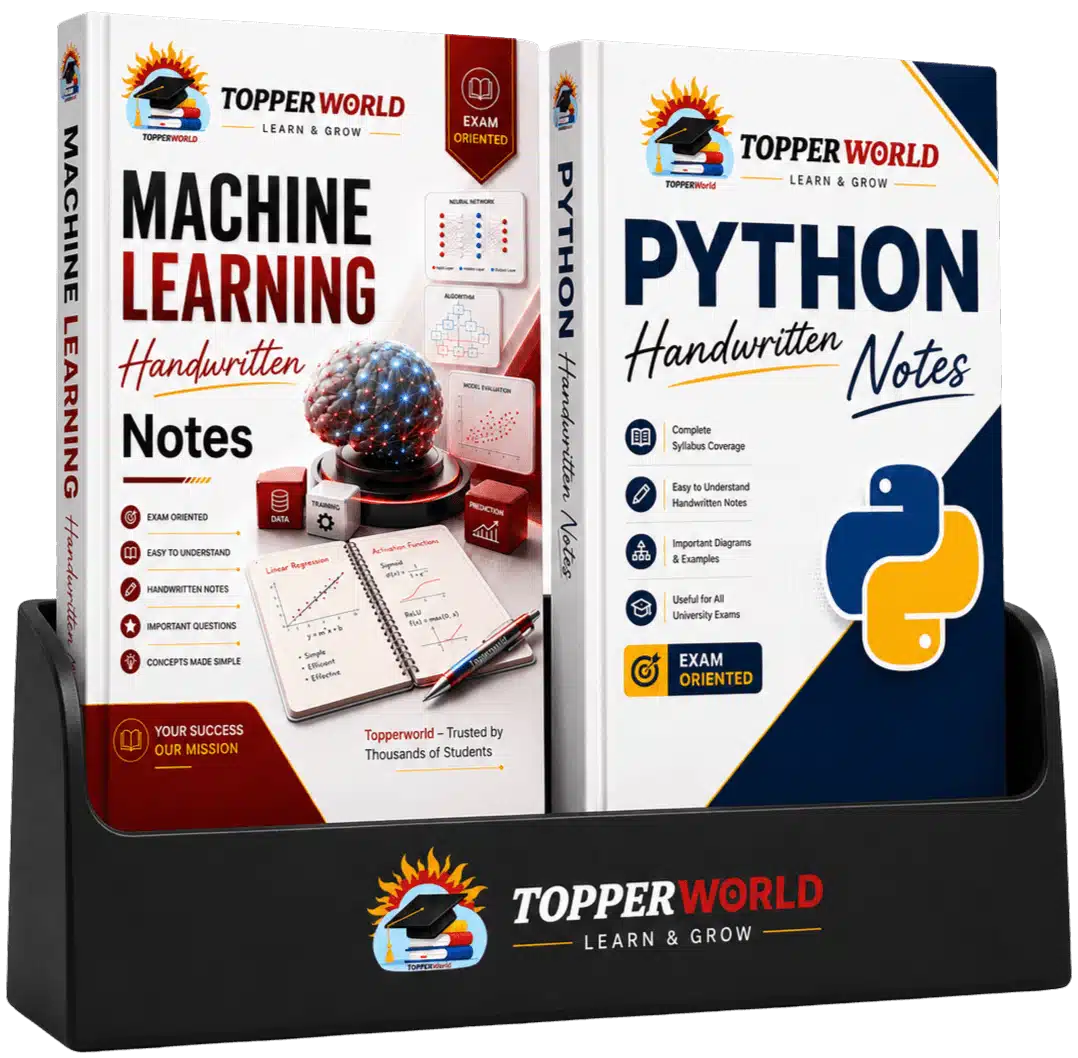
In Python, Data types are a fundamental concept that categorizes and defines the type of data that a variable or object can hold. Data types in Python help the interpreter understand how to store, manipulate, and operate on the data you work with in your programs. Python is known for its dynamic typing, which means you don’t need to declare the data type explicitly when defining a variable; Python infers the data type for you.
In the below PDF we discuss about Data Types in detail in simple language, Hope this will help in better understanding.
- PYTHON PROGRAMMING
Master Core Python Programming Concepts.
Access complete handwritten notes covering loops and functions to prepare for your university exams and technical interviews.
Types of Data Types in Python :
In Python, there are several types of data types that can be broadly categorized into the following categories:
- Numeric Types:
- int (integer): Represents whole numbers, positive or negative, without a decimal point.
- float (floating-point): Represents real numbers with a decimal point.
- complex: Represents complex numbers with both a real and an imaginary part.
- Text Type:
- str (string): Represents textual data and is enclosed in single (‘ ‘) or double (” “) quotes.
- Sequence Types:
- list: Ordered collection of items, mutable (can be changed).
- tuple: Ordered collection of items, immutable (cannot be changed after creation).
- range: Represents a sequence of numbers.
- Mapping Type:
- dict (dictionary): Represents a collection of key-value pairs, where each key is unique.
- Boolean Type:
- bool (boolean): Represents either True or False and is used for logical operations and conditional statements.
- Set Types:
- set: Unordered collection of unique items, mutable.
- frozenset: Unordered collection of unique items, immutable.
Related Question :
A data type in Python is a classification that specifies which type of value a variable can hold. It determines the operations that can be performed on the variable and how it is stored in memory.
Python has four fundamental data types: int (integer), float (floating-point number), str (string), and bool (Boolean).
An int data type is used to represent whole numbers (integers) without any decimal point, while a float data type is used to represent numbers with decimal points or fractions.
You can declare a string in Python by enclosing text within single quotes (‘ ‘), double quotes (” “), or triple quotes (”’ ”’ or “”” “””).
The Boolean data type (bool) is used to represent truth values, which can be either True or False. It’s often used for logical operations and conditional statements.